

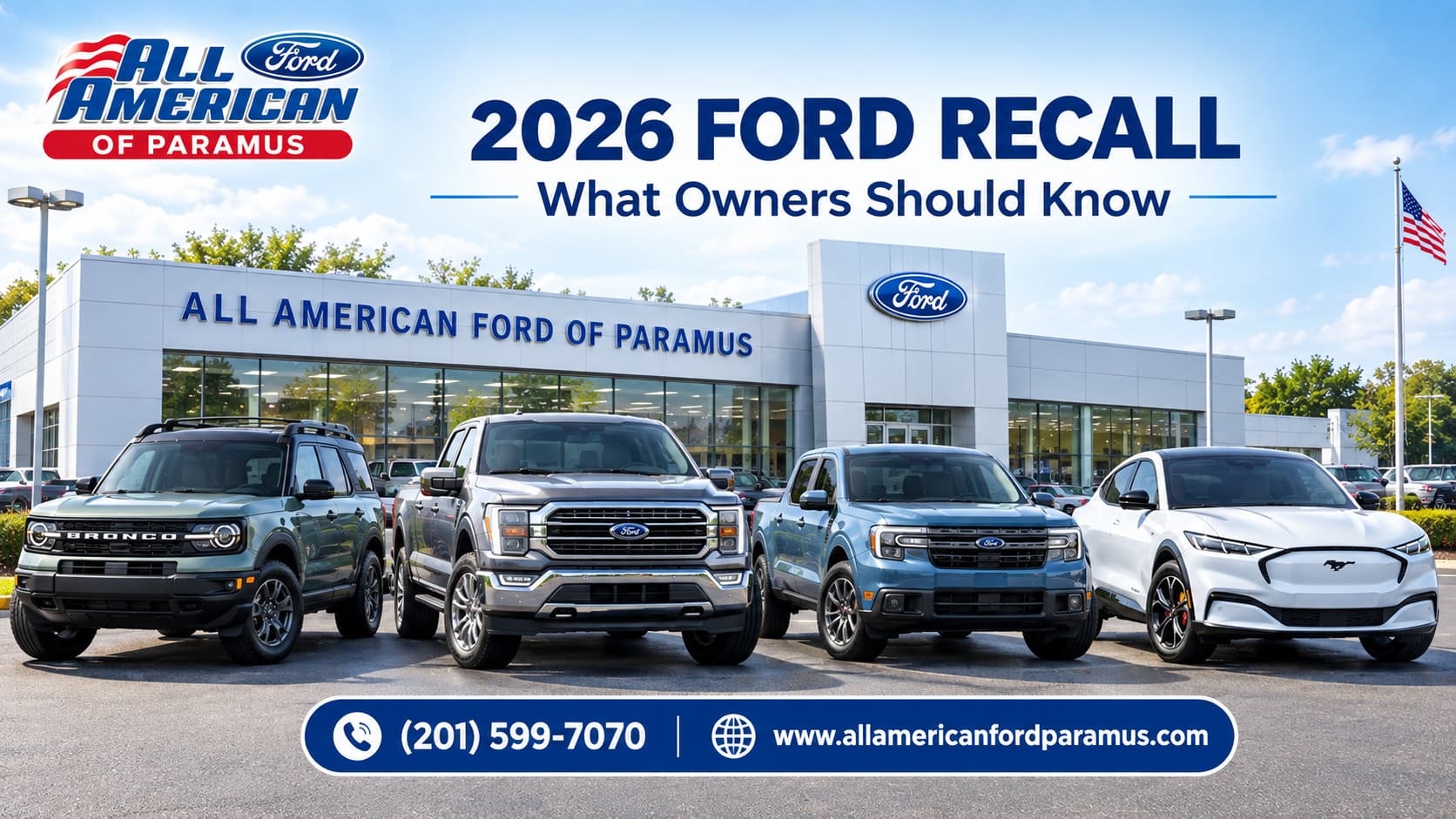
Ford issued several safety recalls in 2026 that impacted a number of vehicles, including the Bronco Sport, F-150, Maverick and Mustang Mach-E. If you own any of these vehicles, the most important step is checking your specific VIN rather than assuming whether you are or aren't affected. Recalls are VIN-specific, not blanket model-year actions. Here is a clear breakdown of each active recall, what it covers, and what owners need to do. Recall 1: Improperly Tightened Vehicle Joints - Bronco Sport, F-150, and Maverick (Ford 26S60 / NHTSA 26V550000) Vehicles affected: Certain 2026 Ford Bronco Sport, F-150, and Maverick vehicles. Note: Ford's recall population includes 23 potentially affected vehicles in the United States. This is a small-scope recall, not a blanket model-year action. Check your VIN to confirm whether your vehicle is affected. What's wrong: Ford has identified that various fasteners, bolts and joints securing components throughout the vehicle may not have been properly torqued during assembly at the factory. The safety risk depends on which specific fastener is affected and what it secures. The affected fasteners fall into two risk categories: Risk 1 - Part detachment If an affected joint secures an external component, that component could detach from the vehicle while driving, potentially creating a road hazard. Risk 2 - Degraded crash protection If the affected fastener secures a crash-critical component, such as a component of the vehicle's seating or body structure, an unsecured part could affect crash protection and increase the risk of injury. Current status: This safety recall was reported in August 2026, with owner notification letters expected to be mailed September 21, 2026. The remedy is expected to become available in October 2026. Dealers will inspect and tighten vehicle joints or repair and replace joint-retention mechanisms as necessary, free of charge. All repairs are free of charge. Do-not-drive advisory: No. There is no do-not-drive order associated with this recall. If you see anything loose, rattling, or operating abnormally on your vehicle, contact your dealer immediately. What to do: Check your VIN. VINs for this recall became searchable on NHTSA.gov on August 26, 2026. If your VIN is confirmed affected, schedule your service appointment with All American Ford. Recall 2: Front Lower Control Arm Ball Joint - Bronco Sport and Maverick (Ford 26S36 / NHTSA 26V340000) Vehicles affected: Certain 2021–2026 Ford Bronco Sport (2,296 units) and 2022–2026 Ford Maverick (2,357 units); 4,653 vehicles total. The overwhelming majority of Bronco Sport and Maverick owners are not affected. Check your VIN immediately to confirm whether your specific vehicle is included. What's wrong: A separation of the front lower control arm ball joint may result in a loss of steering control by the driver, increasing the risk of a crash. Consequence: Loss of steering control significantly increases the risk of a crash. Ford issued a DO NOT DRIVE advisory for vehicles confirmed affected by this recall. Owners are advised to stop driving affected vehicles and contact a Ford dealer to arrange inspection and repair. Current status: Interim owner notification letters were mailed June 4, 2026. Dealers will inspect the front lower control arm ball joint assemblies on both sides and repair them as necessary, free of charge. Additional owner letters will be sent when the remedy is available. What to do: Check your VIN immediately at nhtsa.gov/recalls. If your Bronco Sport or Maverick is confirmed affected, do not drive it. Contact All American Ford to arrange towing and recall service. Ford is arranging complimentary towing for affected vehicles, and mobile inspection may also be available in some areas. Recall 3: Rear Quarter Window Trim May Detach - Mach-E (Ford 26S56 / NHTSA 26V487000) Vehicles affected: Certain 2023–2025 Ford Mustang Mach-E vehicles (86,543 units) What's wrong: The trim around the rear side quarter windows can come loose and detach from the vehicle while driving. Ford identified reports of loose or detached trim associated with the affected vehicles. Why it happens: Improper installation of a rear side quarter-window glass trim may cause it to separate from the vehicle. If the trim detaches while driving, it can create a road hazard for other vehicles. Current status: Recall issued July 28, 2026. VINs are expected to become searchable on NHTSA.gov beginning September 7, 2026. Interim owner notification letters are expected to be mailed September 10, 2026. The remedy, free inspection and replacement of the rear quarter window glass assemblies with properly bonded trim, will follow once parts are available. Do-not-drive advisory: No. Ford has not issued a do-not-drive advisory for this recall. What to do: Check your VIN at nhtsa.gov/recalls after September 7. If affected, schedule service at All American Ford; the inspection and any required glass assembly replacement are free of charge. How to Check If Your Ford Is Affected Every recall is VIN-specific. The fastest way to check: Locate your 17-character VIN, stamped at the base of the windshield on the driver's side and on the door jamb sticker Go to nhtsa.gov/recalls or ford.com/support/recalls Enter your VIN to see all open recalls for your specific vehicle If a recall is listed, contact All American Ford to schedule the repair Recall repairs are performed free of charge at authorized Ford dealers, regardless of whether you are the original owner or how many miles the vehicle has. FAQs Are the 2026 Ford recall repairs free? Yes. Recall repairs for these campaigns are performed free of charge at authorized Ford dealers. My Bronco Sport or Maverick has the ball joint recall (26S36). Can I still drive it? No. Ford has issued a DO NOT DRIVE advisory for Bronco Sport and Maverick vehicles confirmed affected by recall 26S36. Contact All American Ford immediately to arrange service and ask about transportation assistance. Ford is covering towing costs for affected vehicles. When will the fastener torque recall (26S60) remedy be available? Ford expects the official remedy to be available by October 5, 2026. Owner notification letters are expected to be mailed September 21, 2026. How do I know if my Mach-E is affected by the window trim recall? Enter your 17-character VIN at NHTSA's recall lookup after September 7, 2026, when VINs are expected to become searchable. Not every 2023–2025 Mach-E is affected; whether your vehicle is included depends on its VIN. Where can I get my Ford recall repaired near Paramus or Hackensack, NJ? All American Ford dealerships in Paramus and Hackensack are authorized Ford dealers. Call the service department to check on availability of recall service and to schedule your repair.
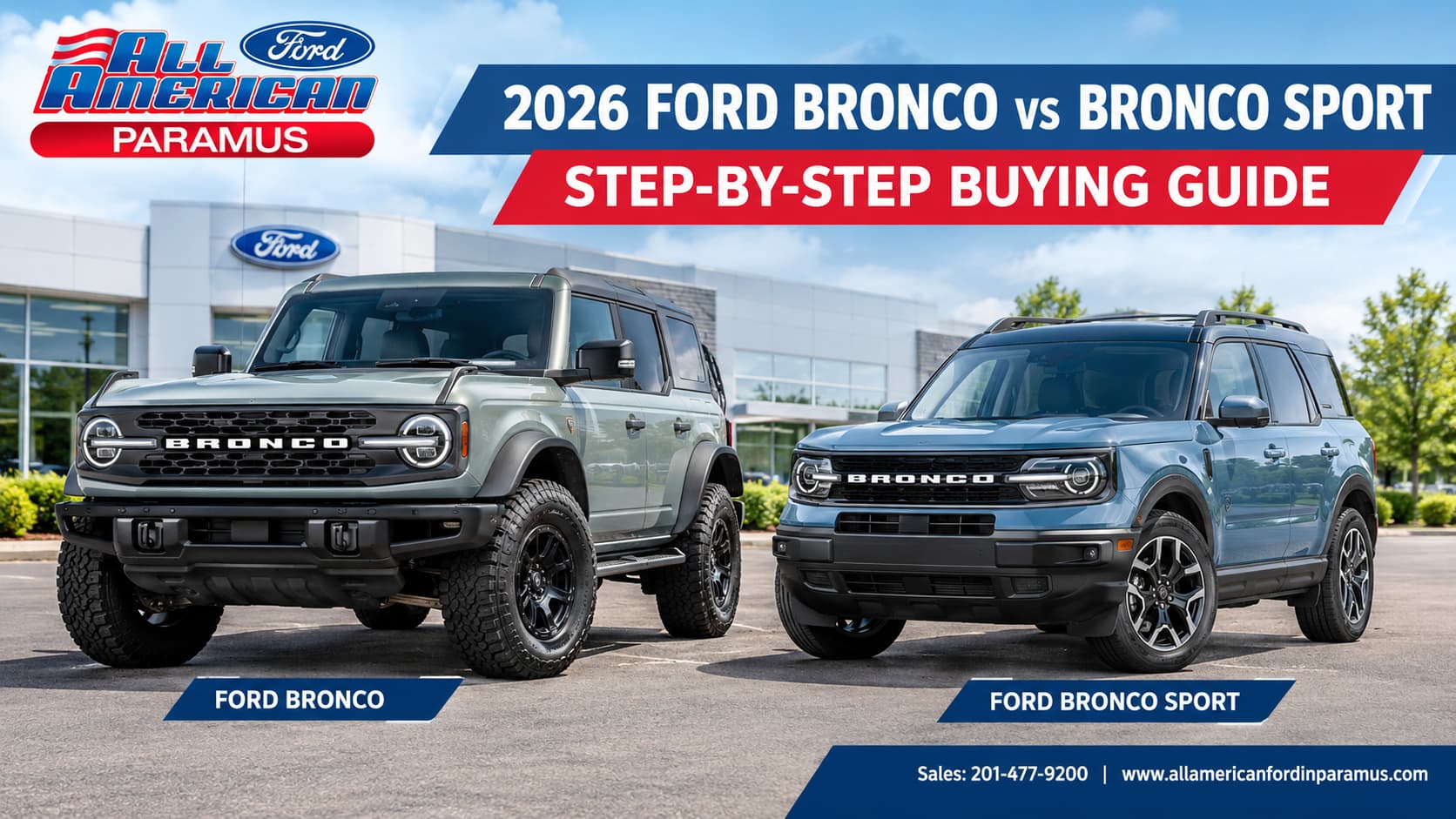
How to Choose Between the Ford Bronco and Ford Bronco Sport: A Step-by-Step Buying Guide
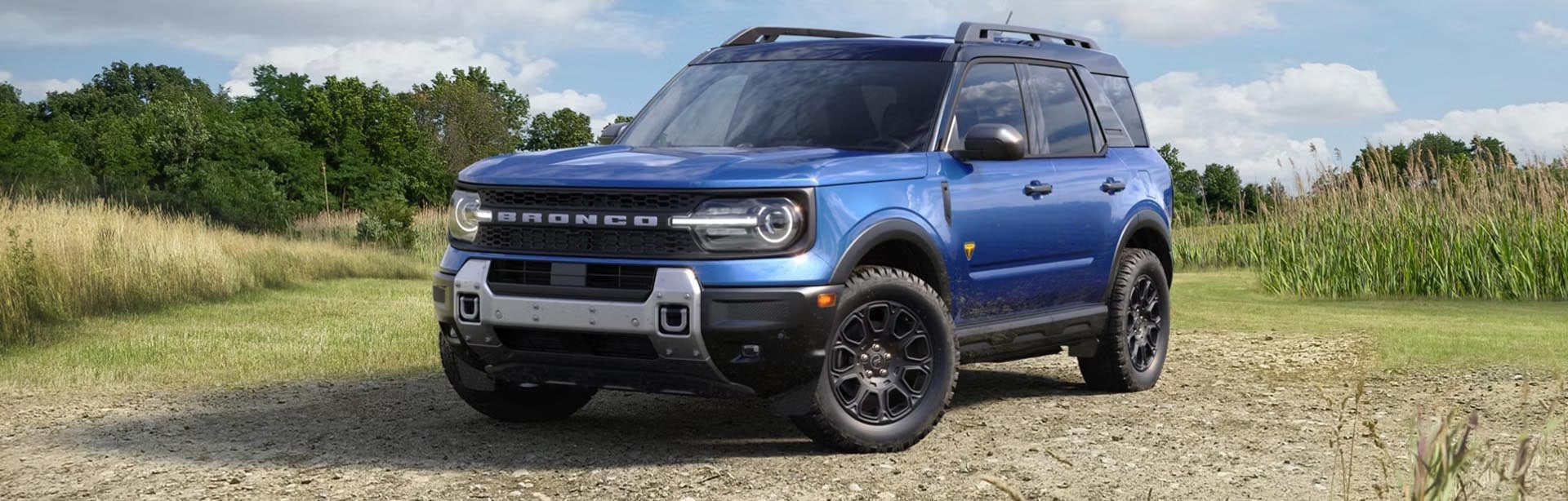
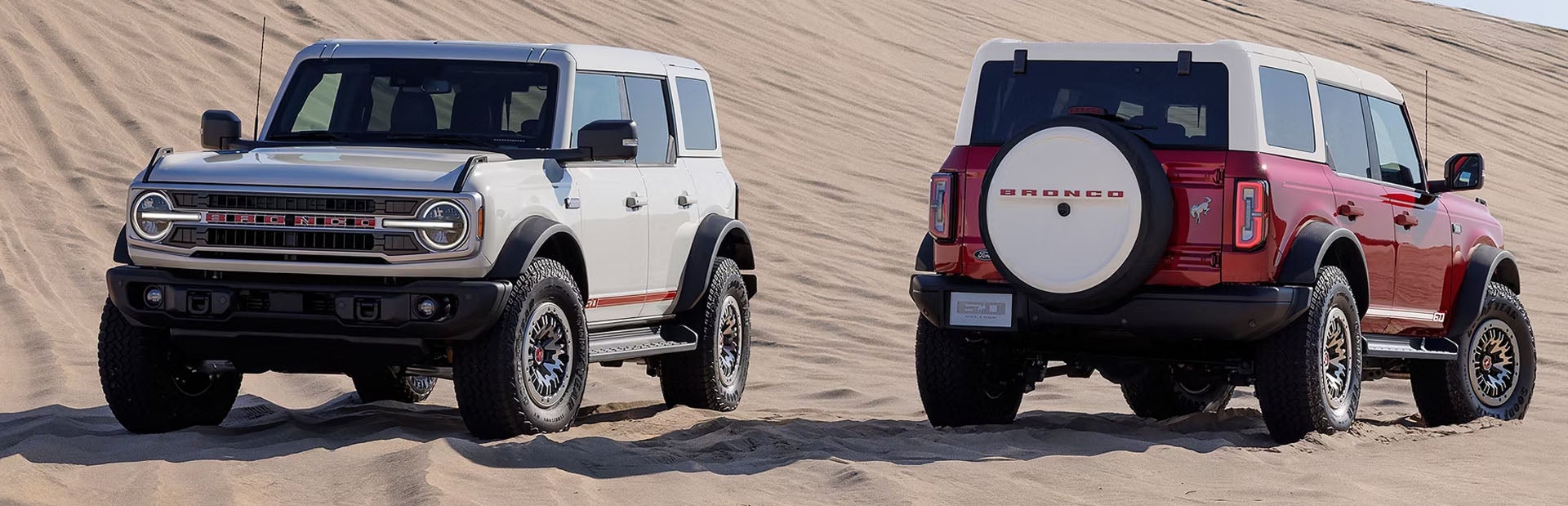
The Ford Bronco and Ford Bronco Sport share a name, a design language, and a dealer lot. Beyond that, they are fundamentally different vehicles, different platforms, different engines, different buyer profiles. Choosing the wrong one means either overpaying for capability you'll never use or underbuying for adventures you actually have. This guide walks you through the decision step by step. Buying Guide: Ford Bronco Vs Bronco Sport Step 1: Understand the Platform Difference - This Is the Foundation of Everything Before comparing specs, understand the structural difference between these two vehicles. It changes everything downstream. The 2026 Ford Bronco is a body-on-frame SUV. It shares its architecture with truck platforms, a separate steel frame beneath the body, solid front and rear axles on higher trims, and a drivetrain designed to handle serious off-road abuse. This is the same fundamental approach used by the Jeep Wrangler and Toyota 4Runner. The 2026 Ford Bronco Sport is a unibody crossover. It shares its platform with the Ford Escape, a car-based architecture that prioritizes ride comfort, fuel economy, and everyday usability over hardcore off-road capability. The Bronco Sport has genuine off-road features, but its structural limits are different from the full Bronco. The takeaway: If the word "off-road" in your vocabulary means unpaved roads, beach access, or light trails, the Bronco Sport handles that comfortably. If it means rock crawling, water crossing, or technical terrain, the Bronco is the vehicle for that work. Step 2: Compare the Specs Side by Side Feature 2026 Ford Bronco 2026 Ford Bronco Sport Platform Body-on-frame Unibody crossover Base Engine 2.3L EcoBoost I-4 1.5L EcoBoost I-3 Base Horsepower 300 hp 180 hp Base Torque 325 lb-ft 200 lb-ft Available Engine 2.7L EcoBoost V6 (330 hp / 415 lb-ft) 2.0L EcoBoost I-4 (250 hp / 280 lb-ft) Drivetrain 4x4 (standard) 4x4 (standard) Ground Clearance Up to 11.6 inches (with Sasquatch® Package; 13.1 inches on Raptor) 7.8 inches (standard); 8.1 inches (Badlands); 8.8 inches (Badlands with Sasquatch® Package) Max Towing 3,500 lbs (up to 4,500 lbs Raptor) 2,700 lbs (Badlands) MPG (Base) 19 city / 21 highway 25 city / 30 highway Seating 4 (2-door) or 5 (4-door) 5 Step 3: Ask Yourself These Three Questions How seriously do you actually off-road? Be honest here. Many buyers use their SUV primarily on-road, so it is important to consider how often you will realistically use advanced off-road capability. If your off-road use is seasonal beach trips, gravel roads, and the occasional dirt trail, the Bronco Sport's standard 4x4 and available GOAT modes (Go Over Any Type of Terrain) handle that without issue. If you're regularly running trails with ledges, deep water crossings, or technical rock sections, the Bronco's higher ground clearance, a solid axle, available locking differentials, and more advanced off-road suspension systems. What's your daily driving reality? The Bronco Sport is significantly more practical for daily use. At 25 MPG city and 30 MPG highway on the base 1.5L engine, it costs less to run every day. Its unibody platform gives it a smoother, quieter highway ride. If your primary use is commuting with occasional adventure, the Bronco Sport fits that life better. The full Bronco at 18 MPG city / 22 MPG highway costs more to fuel on a daily commute. Its body-on-frame ride is firmer and noisier at highway speeds, a trade-off enthusiasts accept because they value the off-road return. Do you need to tow? If towing matters to you- a small boat, a jet ski, a utility trailer- the Bronco's 3,500-lb capacity gives you more flexibility than the Bronco Sport's 2,700 lbs (Badlands) or 2,200 lbs (base trims). Neither is a heavy hauler, but the Bronco has the edge. Step 4: Match Your Profile to the Right Vehicle Choose the Bronco Sport if: Your off-road use is light: beach access, gravel roads, unpaved trails Daily commuting and fuel economy matter to you You want a practical crossover that still looks the part Budget is a real consideration Choose the Bronco if: You regularly run technical off-road terrain You want removable doors and roof panels for open-air driving Towing capacity above 2,700 lbs is part of your regular use You want the full experience the Bronco nameplate was built to deliver Step 5: Test Drive Both Back to Back Reading specs tells part of the story. Sitting in both vehicles and driving them back to back tells the rest. The size difference is immediately noticeable; the full Bronco is substantially larger and taller. The Bronco Sport feels more like a car. The Bronco feels more like a truck. Visit All American Ford If you're in the New Jersey area, browse current Bronco and Bronco Sport inventory at All American Ford Paramus, then schedule a back-to-back test drive if both models are available. Test driving both on the same day is the most efficient way to make this decision. FAQs What is the main difference between the Ford Bronco and Bronco Sport? The Bronco is a body-on-frame SUV built for serious off-road use, with up to 11.6 inches of ground clearance (with Sasquatch® Package) and 3,500 lbs of towing capacity when properly equipped. The Bronco Sport is a unibody crossover built on the Escape platform, with better fuel economy, a smoother ride, and a lower starting price. They share a design language but serve different buyers. Is the Ford Bronco Sport good for off-roading? Yes, for light to moderate off-road use. The Bronco Sport has standard 4x4, GOAT modes, and up to 8.8 inches of ground clearance on the Badlands trim with the Sasquatch® Package (8.1 inches standard Badlands). It handles unpaved roads, gravel, and easy trails well. Technical rock crawling and deep water crossings are outside its design parameters. What is the fuel economy of the 2026 Ford Bronco vs Bronco Sport? The 2026 Bronco is EPA-rated at 19 city / 21 highway MPG on the base 2.3L engine. The 2026 Bronco Sport is EPA-rated at 25 city / 30 highway MPG on the base 1.5L engine; meaningfully more efficient for daily driving. Is the Ford Bronco significantly more expensive than the Bronco Sport? Yes. The Bronco starts at a higher price point than the Bronco Sport, and that gap widens as you move up through comparable trims on each vehicle. The Bronco's body-on-frame platform, more powerful engines, and greater off-road capability all contribute to the price difference between the two. Where can I test drive the Ford Bronco and Bronco Sport in New Jersey? Both are available at All American Ford locations serving the New Jersey area. Contact the dealership to schedule a back-to-back test drive of both models.