


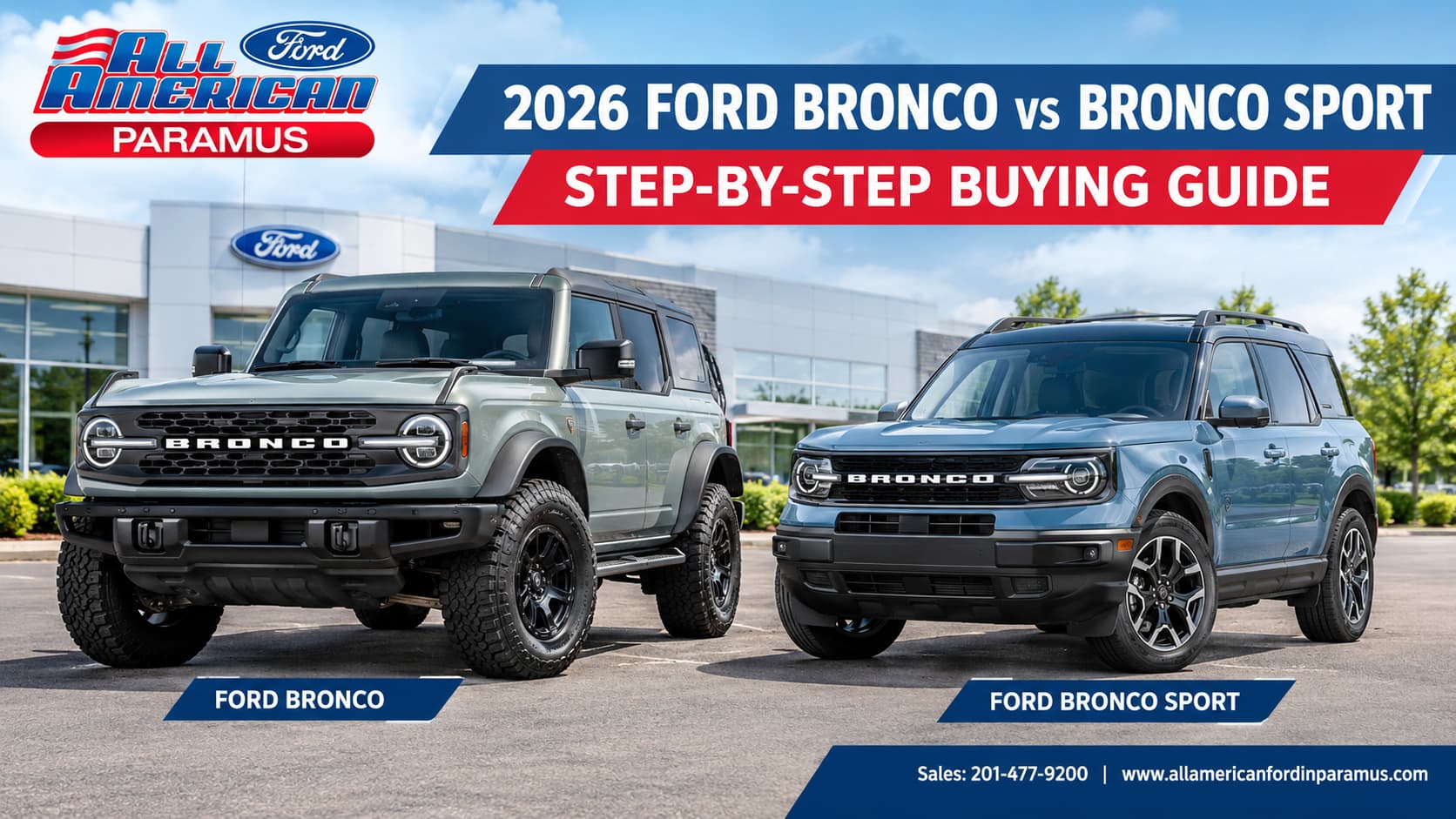
The Ford Bronco and Ford Bronco Sport share a name, a design language, and a dealer lot. Beyond that, they are fundamentally different vehicles, different platforms, different engines, different buyer profiles. Choosing the wrong one means either overpaying for capability you'll never use or underbuying for adventures you actually have.
This guide walks you through the decision step by step.
Buying Guide: Ford Bronco Vs Bronco Sport
Step 1: Understand the Platform Difference - This Is the Foundation of Everything
Before comparing specs, understand the structural difference between these two vehicles. It changes everything downstream.
The 2026 Ford Bronco is a body-on-frame SUV. It shares its architecture with truck platforms, a separate steel frame beneath the body, solid front and rear axles on higher trims, and a drivetrain designed to handle serious off-road abuse. This is the same fundamental approach used by the Jeep Wrangler and Toyota 4Runner.
The 2026 Ford Bronco Sport is a unibody crossover. It shares its platform with the Ford Escape, a car-based architecture that prioritizes ride comfort, fuel economy, and everyday usability over hardcore off-road capability. The Bronco Sport has genuine off-road features, but its structural limits are different from the full Bronco.
The takeaway: If the word "off-road" in your vocabulary means unpaved roads, beach access, or light trails, the Bronco Sport handles that comfortably. If it means rock crawling, water crossing, or technical terrain, the Bronco is the vehicle for that work.
Step 2: Compare the Specs Side by Side
Step 3: Ask Yourself These Three Questions
How seriously do you actually off-road?
Be honest here. Many buyers use their SUV primarily on-road, so it is important to consider how often you will realistically use advanced off-road capability. If your off-road use is seasonal beach trips, gravel roads, and the occasional dirt trail, the Bronco Sport's standard 4x4 and available GOAT modes (Go Over Any Type of Terrain) handle that without issue.
If you're regularly running trails with ledges, deep water crossings, or technical rock sections, the Bronco's higher ground clearance, a solid axle, available locking differentials, and more advanced off-road suspension systems.
What's your daily driving reality?
The Bronco Sport is significantly more practical for daily use. At 25 MPG city and 30 MPG highway on the base 1.5L engine, it costs less to run every day. Its unibody platform gives it a smoother, quieter highway ride. If your primary use is commuting with occasional adventure, the Bronco Sport fits that life better.
The full Bronco at 18 MPG city / 22 MPG highway costs more to fuel on a daily commute. Its body-on-frame ride is firmer and noisier at highway speeds, a trade-off enthusiasts accept because they value the off-road return.
Do you need to tow?
If towing matters to you- a small boat, a jet ski, a utility trailer- the Bronco's 3,500-lb capacity gives you more flexibility than the Bronco Sport's 2,700 lbs (Badlands) or 2,200 lbs (base trims). Neither is a heavy hauler, but the Bronco has the edge.
Step 4: Match Your Profile to the Right Vehicle
Choose the Bronco Sport if:
Your off-road use is light: beach access, gravel roads, unpaved trails
Daily commuting and fuel economy matter to you
You want a practical crossover that still looks the part
Budget is a real consideration
Choose the Bronco if:
You regularly run technical off-road terrain
You want removable doors and roof panels for open-air driving
Towing capacity above 2,700 lbs is part of your regular use
You want the full experience the Bronco nameplate was built to deliver
Step 5: Test Drive Both Back to Back
Reading specs tells part of the story. Sitting in both vehicles and driving them back to back tells the rest. The size difference is immediately noticeable; the full Bronco is substantially larger and taller. The Bronco Sport feels more like a car. The Bronco feels more like a truck.
Visit All American Ford
If you're in the New Jersey area, browse current Bronco and Bronco Sport inventory at All American Ford Paramus, then schedule a back-to-back test drive if both models are available. Test driving both on the same day is the most efficient way to make this decision.
FAQs
What is the main difference between the Ford Bronco and Bronco Sport?
The Bronco is a body-on-frame SUV built for serious off-road use, with up to 11.6 inches of ground clearance (with Sasquatch® Package) and 3,500 lbs of towing capacity when properly equipped. The Bronco Sport is a unibody crossover built on the Escape platform, with better fuel economy, a smoother ride, and a lower starting price. They share a design language but serve different buyers.
Is the Ford Bronco Sport good for off-roading?
Yes, for light to moderate off-road use. The Bronco Sport has standard 4x4, GOAT modes, and up to 8.8 inches of ground clearance on the Badlands trim with the Sasquatch® Package (8.1 inches standard Badlands). It handles unpaved roads, gravel, and easy trails well. Technical rock crawling and deep water crossings are outside its design parameters.
What is the fuel economy of the 2026 Ford Bronco vs Bronco Sport?
The 2026 Bronco is EPA-rated at 19 city / 21 highway MPG on the base 2.3L engine. The 2026 Bronco Sport is EPA-rated at 25 city / 30 highway MPG on the base 1.5L engine; meaningfully more efficient for daily driving.
Is the Ford Bronco significantly more expensive than the Bronco Sport?
Yes. The Bronco starts at a higher price point than the Bronco Sport, and that gap widens as you move up through comparable trims on each vehicle. The Bronco's body-on-frame platform, more powerful engines, and greater off-road capability all contribute to the price difference between the two.
Where can I test drive the Ford Bronco and Bronco Sport in New Jersey?
Both are available at All American Ford locations serving the New Jersey area. Contact the dealership to schedule a back-to-back test drive of both models.